Non-Judgment (Let BE)
Non-Attachment (Let GO)
Non-Resistance (Let COME)
“If good happens, good. If bad happens, good.” (Lao Tzu)
“Mastery of the world is achieved by letting things take their natural course. You cannot master the world by changing the natural way.” (Lao Tzu)
"Unfinished Poem: I would love to live like a river flows, carried by the surprise of its own unfolding." — John O'Donohue
“There is in all visible things an invisible fecundity, a dimmed light, a meek namelessness, a hidden wholeness. This mysterious Unity and Integrity is Wisdom, the Mother of all, Natura Naturans. There is in all things an inexhaustible sweetness and purity, a silence that is a fountain of action and of joy.” (Thomas Merton)
There is Good in all Bad. There is Bad in all Good.
There is no absolute good or absolute bad.
Why? Because good and bad are simply mental constructs that live in our head. Just like right and wrong, sweet and sour, warm and cold, sad and happy. There things that are real, that you can pick up and put in your pocket. And then there are things that are fictions, that exist only in our minds. They are words. And words are never the reality. Words and labels can only point toward the reality that I imagine. Nothing more. We live in an age of dualism where all things are broken apart from the oneness of reality, that which is. We do this because this is the primary way that we can organize, categorize, and understand our world and communicate with each other.
Some of the greatest barriers to freedom are judgement, attachment, and resistance.
Non-Judgement (Let BE)
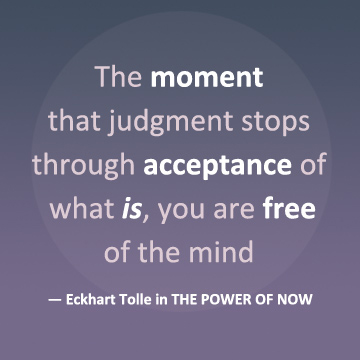
We can never be free unless "we stop judging people, situations or events as good or bad. By conditioning the mind not to judge or label, we perceive the totality of what is rather than dwelling on the thought-form. Any consideration of good or bad leads to either attachment (to what is labeled as good) or resistance (toward what is labeled as bad). In truth, reality is far too complex for us to know what is good or bad—and external events are beyond our control anyway." Non-resistance, non-judgment, and non-attachment are the three aspects of true freedom and enlightened living. (Eckhart Tolle)
The beauty of language is that we are able, of all living creatures, to communicate. This is amazing seeing how complex language is.
The way of language is that we use words as a successive approximation of the reality in our heads. Language uses words and labels, concepts and constructs, to understand reality and communicate with each other.
The problem of language is that we forget. We convince ourselves that words ARE reality, not only our own reality but reality for everyone else too. We love to tell others what is real and true. Therefore we believe the lie that I AM RIGHT and hence YOU ARE WRONG, this is good and hence that is bad. Why? Because I said so. We categorize this complex world so that we can understand it (the beauty and the way of language). But then we deify our own words, thoughts, stories, values, and beliefs above all others. In doing so we force ourselves onto the throne of god and spew judgement on all others; as we sit high and mighty and so haughty drowning in the tyranny of thought.
So, what if I am not right?
What if I am wrong?
What if we are all wrong?
Can that be?
How could that possibly be?
But my real question is this:
How could that possibly NOT be?
When we consider the complexity of this world, how can anyone that defines reality by the stories in their head (hint: all of us) ever be right? We can’t. If I know truth in an absolute and ultimate sense, then that is what is called omniscience; and again, I am forcing myself upon the throne of god while trampling all the others around me, spewing the judgement that ‘they are wrong’ and the ignorance of me not being right.
"A great challenge of life:
Knowing enough to think you are right,
but not knowing enough to know you are wrong."
(Neil deGrasse Tyson)
In a 2,500 year old book called The Tao Te Ching written by Lao Tzu and translated into English by Stephen Mitchell, one of the very first sections in the book discusses the relationship between opposites:
“When people see some things as beautiful, other things become ugly.
When people see some things as good, other things become bad.
Being and non-being create each other.
Difficult and easy support each other.
Long and short define each other.
High and low depend on each other.
Before and after follow each other.”
(Lao Tzu, Tao Te Ching: 2)
Essentially, he is saying that as soon as you make a judgement about something and label it, you are creating the necessity to also create an opposite.
All pain and suffering in life is caused by JUDGEMENT, ATTACHMENT, RESISTANCE.
Why is that? What is there about the core of reality that these three things defy and destroy?
Why do they rob us of our freedom, truth, and reality?
What is the core of reality, the essence of existence? When we dig down to rock bottom, the very ground of being, what we find is only one thing:
ALL THINGS ARE ONE.
There is a HIDDEN WHOLENESS within all things.
And so the core lie at the source of the destruction of reality is the STORY OF SEPARATION AND CONTROL. When we tell ourselves this story, it renders powerful this lie and renders powerless that which is reality, forcing us to live “out of context” with that which is true and real.
Contrary to popular understanding, enlightenment is not akin to the yellow brick road leading to Oz. It is not a path. Rather, it is a remembrance of that which already exists inside of us. Getting there, therefore, is not a matter of learning anything new, but in actuality it is a process of taking out the mental trash that gets in the way – like anything that belongs in the JAR (Judgement, Attachment, Resistance). All of those things are emotional or mental constructs that distract us from the fact that EVERYTHING IS ONE.
https://chadvice.wordpress.com/2012/08/27/a-conversation-with-god/
Non-Attachment (Let GO)
“We refuse to become attached to that which is external and impermanent. We understand that love, lasting happiness, enjoyment and liberation originate internally—and so there is no reason to become attached to anything external.” Non-resistance, non-judgment, and non-attachment are the three aspects of true freedom and enlightened living. (Eckhart Tolle)
Non-attachment is much more than not becoming attached to one’s material possessions.
“Non-attachment is not clinging to fixed ideas, not clinging to the way you think things should be but actually opening to the way things really are.” (Michael Stone)
Non-attachment is more like full engagement in all things. Living a life that is fully immersed in reality, in things as they are. “To see how everything leans into everything else and wake up to the inherent interconnection of all things. But to do it in a way that is not attached.”
Once we think that we have “achieved” the enlightenment of seeing and knowing the interconnectedness of all things, right there we have lost it. By knowing, we dominate and cling and judge.
“How do we become intimate with the way things are underneath language, underneath our concepts of how we think things should be. This is really the heart of non-attachment, this deep engagement”
“Fixed and rigid ideas are really the enemy of intimacy. It’s really what shuts down relationships. We are living in a time when we don’t need any more ideology or philosophy, what we really need is a way to let go and to drop in to the truth of the way things are economically, emotionally, ecologically, socially, and that includes both what is beautiful and what’s devastating; opening up the fact that this world is both stunningly beautiful and a total catastrophe and how to hold both. Opening up to both the joys of being alive and also to the suffering that is inherent in being in a body and aging in a world that really needs our help. So I think we need to reimagine non-attachment as letting go of fixed ideas so that we can become fully engaged in a world that needs us. This world needs us and our actions make a difference. So how do we rethink spiritual practice not as trying to transcend, not in being dissociated, not as witnessing our lives, but as being totally immersed in life.”
“Consider the trees which allow the birds to perch and fly away without either inviting them to stay or desiring them never to depart. If your heart can be like this, you will be near to the way.” (Zen Proverb)
Recognizing and removing dogma is
“just a way of clearing the space for better conversations.” (Sam Harris)
Non-Resistance (Let COME)
"Unfinished Poem: I would love to live like a river flows, carried by the surprise of its own unfolding." — John O'Donohue
“We accept that whatever is happening this moment is simply what is happening. It cannot be argued with or avoided. Non-resistance recognizes that which is external to us as that which we cannot control—nor would we want to. Everything happening in our life is part of life’s perfect curriculum for us.
“We do not know what is good or bad. There are too many variables. There is enormous wisdom and happiness found in the practice of simply accepting what is and doing our best without becoming attached to any particular result. We continue tomorrow and each day after that.” Non-resistance, non-judgment, and non-attachment are the three aspects of true freedom and enlightened living. (Eckhart Tolle)
Eckhart Tolle defines nonresistance as being one with what happens. It is about welcoming events in life (good or bad) without labeling them or letting them take power over you.
“Water is fluid, soft, and yielding. But water will wear away rock, which is rigid and cannot yield. As a rule, whatever is fluid, soft, and yielding will overcome whatever is rigid and hard. This is another paradox: what is soft is strong.” (Lao Tzu, Tao Te Ching)
All of my life I’ve been taught that there are certain things that are right and others that are wrong, some things are good and others are bad. But the only way that we have come to think this way is through the story of separation. When we separate ourselves from nature, then we can conjure up our own illusions about life and about this world. But if we seek to follow the natural course of things, stop resisting “that which is”, then we can live like all of creation. In nature, there is no good or bad, right or wrong. Have you ever seen a river stop because it is going the wrong way? Have you ever seen the ocean waves suddenly change direction? Have you ever seen a storm that has regrets for the damage it did? NO! Nature does what nature does. Natura naturans (nature naturing). Why would it be any different for human beings if we are seeking to follow the natural way? Why fight that which is? The power of the universe has proven itself to be true through the ages. That’s good enough for me. Maybe we should stop destroying that which nurtures us and sustains us and teaches us. It always has and it always will. And when we lose our way, this is only because we have lost the natural way. Things become unclear and mirky.
“Muddy water, let stand, becomes clear.”
“Do you have the patience to wait
Till your mud settles and the water is clear?
Can you remain unmoving
Till the right action arises by itself?”
Lao Tzu Tao Te Ching Chapter 15
Mastery of the world is achieved
by letting things take their natural course.
You can not master the world by changing the natural way.
Tao Te Ching: 48
By Lao-Tzu
One who seeks knowledge learns something new every day.
One who seeks the Tao unlearns something new every day.
Less and less remains until you arrive at non-action.
When you arrive at non-action,
nothing will be left undone.
The gentlest of all things;
that which offers no resistance,
can overcome the hardest of things.
That which has no substance
can enter where there is no space.
Hence I know the value of non-action.
~
Few things are as instructive
as the lessons of silence.
Teaching without words,
performing without actions –
few in the world can grasp it –
that is the Sage’s way.
Tao Te Ching: 43
By Lao-Tzu
When Things Fall Apart
Another way of seeing things
Bad or Evil or Wrong are labels for interpretations by self. So that in and of itself makes those interpretations suspect. Maybe the discomfort we feel are versions of our own constructs of control and certitude. Maybe they are simply part of the process of change.
"The word change normally refers to new beginnings. But transformation more often happens not when something new begins but when something old falls apart. The pain of something old falling apart—disruption and chaos—invites the soul to listen at a deeper level. It invites and sometimes forces the soul to go to a new place because the old place is not working anymore. The mystics use many words to describe this chaos: fire, darkness, death, emptiness, abandonment, trial, the Evil One. Whatever it is, it does not feel good and it does not feel like God. We will do anything to keep the old thing from falling apart. This is when we need patience, guidance, and the freedom to let go instead of tightening our controls and certitudes."
~ Richard Rohr


